Finding New NSFW AI Characters Without Endless Scrolling
A character feed is built for browsing rather than for finding, and the difference shows the moment you know what you want. The trends list holds 20 cards and is rebuilt every Thursday, so a week of scrolling circles the same names. Eri's card alone records 24.3M views against 7.1K favourites, a save ratio of roughly 0.029%, which is why filters convert better than patience.

Key takeaways
- Popularity is exposure, not fit: 7.1K favourites against 24.3M views works out at about one save per 3,400 views.
- Combine one tag with one platform filter, such as Submissive with Unfiltered, instead of reading a whole page of cards.
- The weekly chart is refreshed every Thursday, so mid-week browsing often revisits names you already skipped.
- Three saved cards you return to beat fifty you cannot remember.
The real cost of an unfiltered browse
Give a browse session a unit cost and the argument for filtering stops being about taste. If you read a card in 20 seconds, ten minutes carries you through roughly 30 cards; at 45 seconds each, the same ten minutes covers about 13. Those two figures are an illustrative assumption rather than platform data, but they set the scale of the problem: every second spent on a card you will not open again is a second not spent narrowing the list.
Feeds also repeat faster than they refresh. Twenty entries rebuilt weekly means the top of the page is effectively static for seven days, so a Friday visit and a Tuesday visit show the same covers, the same short blurbs and the same counters. That is why a two-minute browse in the middle of the week so often feels like a rerun of the weekend.
None of this makes a trends page worthless. It makes it a signal rather than a search box: excellent at showing what the week looks like, poor at answering a specific request such as a fictional character with a tone you have not seen before. The tool for the second job sits one navigation step away.
Turning tag vocabulary into a query you can repeat
Labels are the raw material of a good query. Cards for NSFW AI characters carry tags such as Unfiltered, Submissive, Fictional, OC and Female, and the platform's character search lets you stack that vocabulary on top of its own filters, including the Filtered, Unfiltered and 18+ states and a gender filter. Two deliberate conditions cut a page of results faster than any amount of scrolling.
A repeatable query beats a lucky one. Restate what you want in plain words, for example an unfiltered fictional character with a creator you have not chatted with, and the same wording can be reused next week and refined. Queries you can write down are queries you can improve; a browse session leaves nothing behind but fatigue.
Creator credits deserve attention too. Cards on Crushon carry a byline, so a single creator can be treated as a style. When one character's pacing suited you, that creator's other work is a shorter path than a fresh sweep of the front page, and the byline filter in a search narrows the field instantly.
Reading counters before opening a card
Views measure exposure and favourites measure intent, and the gap between them is the useful part. Eva's card shows 19.1M views with 2.8K favourites, about 0.015% or one save per 6,800 views; Takara sits at 18.2M with 4.7K, about 0.026%; Eri converts at about 0.029%. All three are popular, but they are not equally persuasive to the people who actually stopped.
Treat the ratio as triage rather than as a verdict. A card with enormous reach and a thin save rate is well placed rather than well matched, while a card that converts at twice that rate is doing something its audience recognises. For a reader with fifteen minutes, the ratio is a better ordering than the rank number on its own.
| Signal on the card | What it actually measures | How to use it |
|---|---|---|
| View count | Total exposure across everyone who opened the card | Triage only; a large number says nothing about fit |
| Favourite count | Deliberate saves, about one per 3,400 views on Eri and one per 6,800 on Eva | The stronger indicator of repeat interest |
| Creator byline | Who built the character | A shortcut when one creator's style already works for you |
| Tag line | The vocabulary the search page shares | Copy a tag into the query instead of describing it |
| Weekly rank position | Where the card sits on this Thursday's list | Context for a spike, never a reason on its own |
The saving is measured, so the ordering should be too. Pair a high save ratio with a tag that is genuinely narrow, and the first two results of a query usually deserve a proper conversation.
Worked example: what your own pace implies
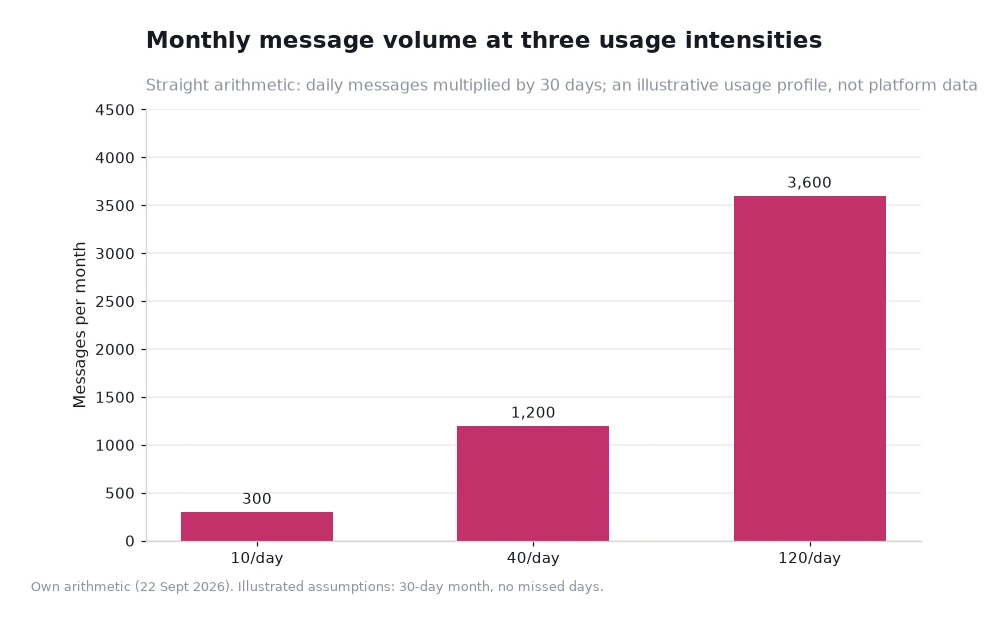
Take three message paces an adult user might recognise, then apply a 30-day month as an illustrative assumption: 10 messages a day multiplied by 30 days gives 300 messages a month; 40 a day gives 1,200; 120 a day gives 3,600. The heaviest profile is twelve times the lightest, and that multiple, not the raw total, should decide how hard you need to work at discovery.
A reader at 300 messages a month has room to experiment, because an unsatisfying conversation costs little of the month's attention. A reader at 3,600 has the opposite incentive: every weak opening wastes a larger share of a fixed monthly volume, so narrow queries and a saved shortlist save more time than a wider sweep of the chart. Same platform, two different search disciplines.
Making a shortlist survive the week
A workable routine takes minutes: run one saved query, open the two most convincing cards, and save only what earns a second visit. Treat the nsfw ai chat list as a weekly input rather than a daily habit, and let your own favourites define the next round of queries instead of the front page.
Then check the board that tracks movement. A glance at the weekly rankings once a week is enough to see which names are rising, and a name that rises while also converting at a high save rate is the closest thing to a safe opening move. Two minutes on the board, five on the query, and the rest of the session belongs to conversation rather than to scrolling.
Everything else follows from the same principle: describe what you want, verify it against the counters, and keep the winners. Scrolling is what remains when neither step happened.
Frequently asked questions
How many filters should I combine at once?
Two is usually the sweet spot: one tag that describes the character and one platform filter that describes the content state. A third condition often returns nothing.
Does a high view count mean a character is better?
No. Views show exposure, and the save rate shows intent. Eri converts at roughly 0.029% and Eva at about 0.015%, so the two measures rank cards differently.
How often is the trending list updated?
The weekly chart is rebuilt every Thursday, which is why checking it more than once a week rarely shows anything new.
Start with the query, not the feed
Write down the two conditions that describe what you actually want, run them as a single query, and open only the cards whose save ratio suggests other people returned. Add one favourite to the list each week and drop anything you have not revisited for a fortnight. Discovery stops being an hour of scrolling and becomes a five-minute habit.
Data and sources: the 20-card character list and its counters, including the 24.3M views and 7.1K favourites on Eri's card, were read from Crushon on 22 Sept 2026; monthly message totals are an illustrative assumption of 30 days at three daily paces. Save ratios are arithmetic on those counters.[1] Written for readers aged 18 and over.