First Month Without a Host: 479 TH/s on Your Own Dashboard
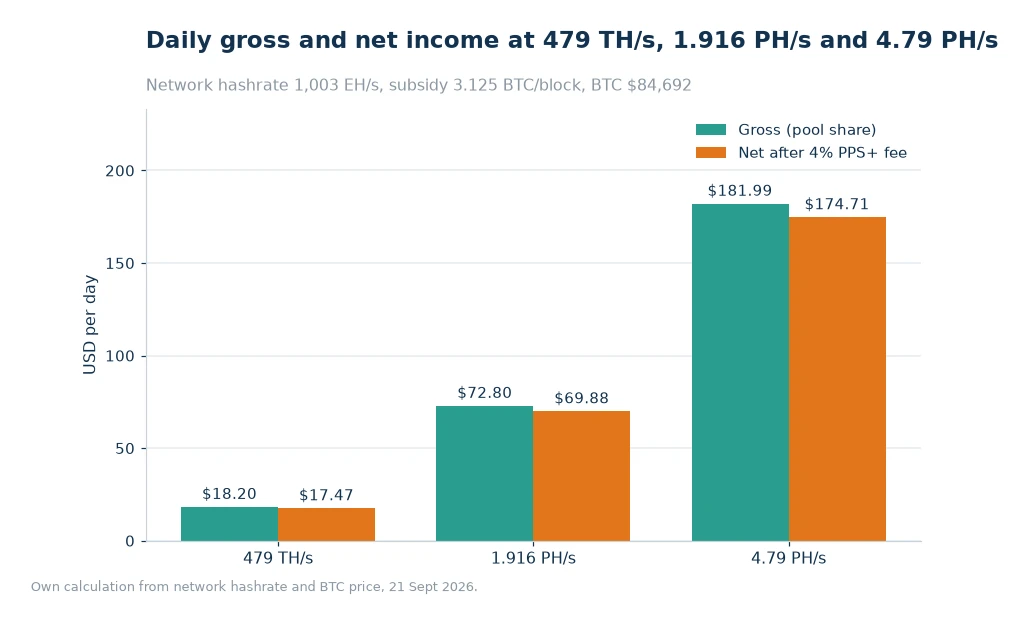
Leaving a hosting contract feels like a promotion and reads like a payroll cut. The coins arrive at the same rate as before, about 0.00021488 BTC a day for 479 TH/s, which is $18.20 gross at $84,692 and $17.47 after the listed 4% on the block-reward component. What changes is that every hour of uptime now depends on a room you control and a phone that rings for you.
Key takeaways
- 479 TH/s earns 0.00021488 BTC a day, or $17.47 net, the same as it did under the host.
- The host was selling three things: power, uptime and someone else's attention.
- Budget the first month for a repair and a spare, not just for electricity.
- Reconcile at day 30 against the host's last statement before drawing conclusions.
What the invoice was really paying for
A hosting fee looks like a single number, but it buys three separate services. The first is power at a rate you probably could not negotiate alone. The second is uptime: redundancy, spare parts, a technician who notices at 3 a.m. The third is administrative cover, from permits to insurance to the argument with the utility.
When the machine moves home, all three become yours. Only one of them is visible on a bill. The other two show up as time, and time is the input most miners underprice when they run the comparison that convinces them to leave.
None of this argues against self-hosting. It argues for counting the work before deciding the fee was too high. A miner with a suitable building, cheap power and a flexible schedule can do better alone. A miner with a flat and a 3 kW service cannot, no matter how the spreadsheet is arranged.
The first thirty days, honestly
Week one is calibration. The machine runs at your ambient temperature, not the hall's, so the fan curve behaves differently and the reported hashrate may sit a little below the hosted figure. Record the daily average rather than reacting to a single afternoon.
Week two is when the first small failure usually appears. A fan, a network cable, a pool connection that drops after a router reboot. Handle it yourself and time the repair. That number, in hours, is the true cost of the service you stopped buying.
Week three is the power bill's first full appearance. Compare it with the credit total, not with the previous month under the host. Weeks four onwards are the routine, and the routine is what decides whether the move was right.
Keep a note of the first time the machine stops unexpectedly. The interval between installation and that event is your observed reliability, and it is a better guide than any claim on a specification sheet. If the first stop comes on day three, the room has a problem. If it comes on day forty, the machine is behaving like a machine.
| Task | Under a host | As your own operator |
|---|---|---|
| Uptime monitoring | Included, staffed | Your alerts, your phone |
| Fan or PSU failure | Technician on site | Your spare, your hours |
| Power contract | Negotiated by the host | Your tariff, your meter |
| Payout control | Usually yours already | Unchanged: 0.00021488 BTC a day |
Worked example
Compare the hosted month with the self-managed one using the same revenue line and two different cost lines.
- Between them, 1,003 EH/s and 450 BTC a day give 450 ÷ 1,003,000,000 = 0.00000044865 BTC per TH/s.
- 479 TH/s: 479 × 0.00000044865 = 0.00021488 BTC a day.
- Gross dollars: 0.00021488 × 84,692 = $18.20.
- The 4% listed on the block reward takes it to 18.20 × 0.96 = $17.47.
- Thirty days: 0.00644640 BTC, or $546.00 gross and $524.10 net.
- At 20 J/TH the unit draws 9.58 kW, so a month is 6,897.6 kWh; at $0.06 that is $413.86.
- Margin before hardware: $524.10 − $413.86 = $110.24, which has to cover the repair time the host used to supply.
Rebuilding the maintenance calendar
The hall had a schedule you never saw. Filters changed on a rota, firmware updated in batches, fans replaced before they failed. Recreate that rhythm in a spreadsheet with four recurring entries: clean the intakes monthly, inspect fans quarterly, review firmware twice a year, test the restart procedure once a season.
Add an entry that is easy to skip: check the torque on the power connections once a year. Loose connections heat up, and a warm plug is a fire risk long before it is a mining problem. A thermal camera or an infrared thermometer makes this a five-minute job.
Record every intervention with a date and a part number. When a unit is eventually sold, that log is worth more than a clean case, and when a part fails twice the log tells you to change the surrounding cause rather than the part again.
Keep the calendar where you will see it, not inside a folder you open twice a year. A wall chart with four repeating entries is more reliable than a reminder that arrives after the machine has already throttled.
The costs that only appear when you own the room
Insurance is the first. A hosted contract usually includes some cover for the equipment on site; at home, a standard policy may exclude mining hardware or cap it below replacement value. Read the policy before the machine is installed, not after a loss.
The second is cooling capacity. The hall had spare headroom. A room sized for one machine has none, so the second unit needs a new duct or a new room rather than a new shelf. That cost lands at the moment of expansion, which is exactly when a miner is least inclined to spend on anything but hardware.
The third is your own time, and it deserves a number even if it never appears in a bank statement. If a repair takes four hours and a replacement part costs $60, the repair is not free just because no invoice was issued.
There is a fourth cost that rarely gets written down: the loss of a second pair of eyes. In a hall, a technician walking the aisle notices a hot exhaust or an unusual noise without being asked. At home, nobody walks the aisle. That absence is precisely why the monthly cleaning rota and the temperature alert exist, and it is why a miner who travels for work should think twice before giving up a hosted slot.
ViaBTC Bitcoin Mining keeps the worker, the mode and the balance in one account regardless of where the hardware sits, so the comparison is a matter of two exports rather than two systems.
For a miner considering a return to hosting, the Mining Farms listings and the Miner Hosting directory cover the supply side. Leaving is reversible, and knowing the options makes the decision less emotional.
Frequently asked questions
Does leaving a host change what the pool pays?
No. The credit at 479 TH/s is 0.00021488 BTC a day wherever the machine runs, because payout follows shares and difficulty rather than the building.
What does self-managing cost per month?
At 20 J/TH and $0.06/kWh the power line is about $413.86 a month against $524.10 of net credits, leaving $110.24 before hardware, spares and your own hours.
How long before I know the move was right?
One full month and one full difficulty window, compared against the host's last statement, is enough to see whether the savings survive the added work.
Compare two statements, not two feelings
Put the host's final month beside your first month. Same hashrate, same pool rate, different cost lines. If the gap is positive after a repair, a spare and your hours, the move worked. If it is negative, the host was charging a fair price for work you did not want to do.
Then keep both files. The pair is the only evidence that the decision was made on numbers rather than on a feeling about fees, and it is the baseline for the next time the question comes up.
Sources: ViaBTC farms, companies and account pages for hosting categories and settlement terms[1]. Published 24 Oct 2026; inputs read 21 Sept 2026 (1,003 EH/s, 132.76 T, 3.125 BTC every block, 144 blocks a day, $84,692 per BTC). Power is costed at a flat $0.06/kWh with 20 J/TH assumed.