What Drives the Price of a Solar Cable
Most of the money in a photovoltaic cable is metal, and the manufacturer publishes the amount: the cross-section table puts a 4 mm² conductor at 59 g/m, a 6 mm² at 78 g/m and a 10 mm² at 130 g/m. Because the site prints no unit prices, the honest way to read a solar cable price is to compare the mass of copper behind it, then add the cost of the compounds and the testing that the same pages describe. KUKA CABLE, a cable manufacturer in Jinshan District, Shanghai, publishes both halves of that picture on its solar cable pages.

Key takeaways
- Nominal weights are published as 59 g/m for the 4 mm², 78 g/m for the 6 mm² and 130 g/m for the 10 mm².
- Construction published for the 1500 V cable: tinned copper, class 5 to IEC 60228, with electron-beam cross-linked XLPO insulation and sheath.
- Two tests are printed for the manufacturing stage: spark testing at 10 kV, then a five-minute 6.5 kV AC, 50 Hz check on the completed cable.
- No unit price, price per metre, minimum order quantity, lead time or freight rate is published, so those belong on the quotation.
The visible driver: copper per metre
Start with the number a buyer can check with a scale. The cross-section table lists a nominal weight for every size, so a 6 mm² cable is 78 g/m and a 10 mm² cable is 130 g/m before any packaging. Those two figures differ by 52 g/m, and the step from 4 mm² to 6 mm² differs by 19 g/m, which is the same arithmetic that decides how much copper a supplier has to buy for a given order.
Using the published figures makes quotations comparable. If one offer states 78 g/m for 6 mm² and another states 90 g/m for the same nominal size, the second is 12 g/m heavier, which is 15% more material per metre; both ratios are my own calculations on the published table. A third offer that states 70 g/m is about 10% lighter than the published build, which may be a thinner sheath, a different strand construction or simply a typing error, and the only way to know is to ask for the strand build on the datasheet.
The second driver: compounds and cross-linking
The copper is the easy half of the cost to see. The compounds are the harder half, and the pages describe them in more detail than a price list would. Insulation and sheath are both XLPO, cross-linked by an electron beam and described as low smoke halogen free, with the conductor tinned rather than bare. Each of those words is a decision that costs money at the factory: tinning protects the strands, cross-linking takes energy and equipment, and a halogen-free compound is formulated rather than bought off a standard rack.
The material also has to pass tests that a cheaper compound fails. The published figures include a tensile strength before ageing of at least 8 N/mm² and an elongation before ageing of at least 125%, with the manufacturer stating that its photovoltaic cables reach up to 185%. The 2,000-hour xenon lamp test described on the laboratory pages is long enough that it cannot be faked by a sample sent for testing on the day it is ordered.
The third driver: testing and inspection time
Every metre of the published construction passes a spark test at 10 kV, and the finished cable is tested at 6.5 kV AC at 50 Hz for 5 minutes. The laboratory, running since December 2015 and described as an ISO/IEC 17025 laboratory, publishes a test list that covers water resistance, UV accelerated weathering, abrasion, cold bending, cold elongation, tensile testing after ageing, solderability, static flexibility and construction and dimensional checks. On top of that the manufacturer describes a quality model in which finished products receive 100% inspection and samples are retained for traceability.
None of that is free, and none of it appears in a price per metre. It is the part of a quotation that a buyer only notices when something goes wrong on site, which is why the test pages are worth reading before the commercial discussion rather than after it.
The fourth driver: certificates and market access
A cable sold into Europe, North America and Australia does not carry one document but a set of them. The manufacturer's certificates page lists more than 30 types of certificates including TUV, IEC, CE, SAA and UL, and describes the UL document as being updated. The 1500 V solar cable specification names TUV 2PfG 1169/08.2007, EN 50618:2014 and IEC 62930 in a single row, and the site highlights CPR as a fire rating and AD8 as a waterproofing rating.
Keeping a document set current is a running cost, and it is one of the reasons two cables with identical dimensions can arrive at different prices. A buyer should ask for the certificate that covers the model offered, because a general list of certificate names does not say which cross-section was actually tested.
| Cross-section | Conductor construction | Nominal weight | Mass index (author's calculation) |
|---|---|---|---|
| 4 mm² | 56 × 0.29 mm | 59 g/m | 100 |
| 6 mm² | 84 × 0.29 mm | 78 g/m | 132 |
| 10 mm² | 142 × 0.29 mm | 130 g/m | 220 |
| 16 mm² | 238 × 0.29 mm | 190 g/m | 322 |
| 25 mm² | 375 × 0.29 mm | 292 g/m | 495 |
Worked example
Price a 1,000 m order from the published table alone. At 6 mm² the weight is 78 g/m, so the order contains 1,000 × 78 = 78,000 g, or 78 kg of cable; that multiplication is mine and it excludes the drum, the pallet and any packaging. Do the same at 10 mm² and the figure becomes 1,000 × 130 = 130,000 g, or 130 kg.
The difference between the two sizes on the same length is 130 − 78 = 52 kg, which is exactly the difference between a 6 mm² and a 10 mm² conductor plus its thicker walls. If the quoted price per metre rises by less than the mass rises, the offer is buying less metal somewhere; if it rises by more, the difference is sitting in compounds, testing, certificates or freight. Both statements are my own reasoning on published figures, and neither replaces a written price from the supplier.
The published weights on one chart
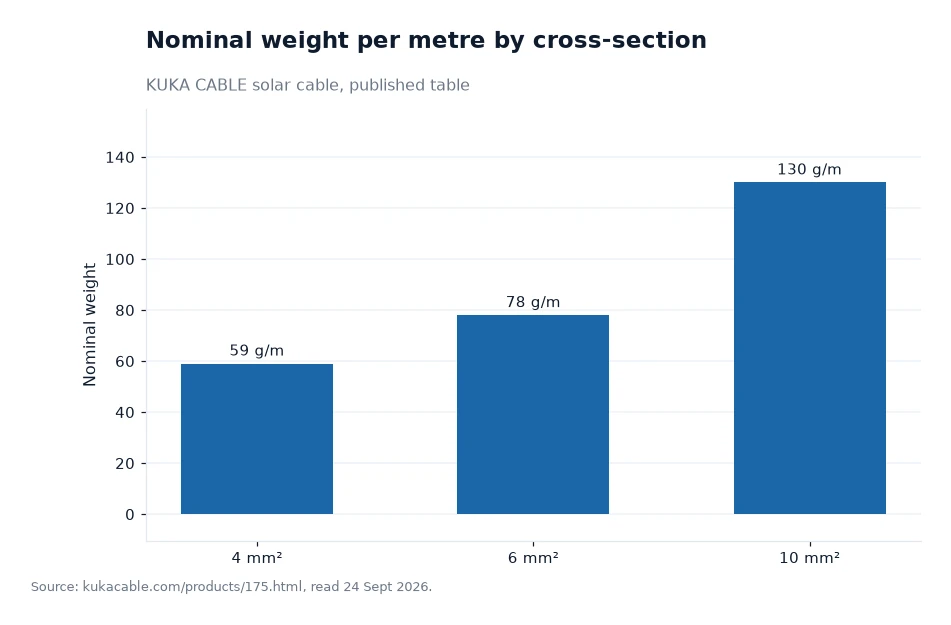
The bars are a material budget in grams, not a price. Their shape explains why the price of a cable order moves faster than the cross-section number suggests: going from 4 mm² to 10 mm² multiplies the conductor and wall mass by 130 ÷ 59 = 2.2, so a buyer who steps up a size should expect the metal content to more than double even though the number in the catalogue only rises from four to ten.
Frequently asked questions
Why does the manufacturer not publish a price per metre?
The pages carry dimensions, weights, standards and test values, but no unit price, price per metre, minimum order quantity, lead time or shipping rate. Those depend on the specification, the volume and the destination, so they are quoted by the sales contact and confirmed in writing rather than printed on the website.
Which published figure should be used to compare two prices?
Use the nominal weight per metre from the cross-section table, then confirm the strand build and the wall thicknesses on the datasheet. A second useful figure is the elongation before ageing of up to 185%, because it is published next to the 125% requirement and describes the compound rather than the copper.
What to ask for with the quotation
Send the cross-section, the standard, the length and the destination, then ask the supplier to quote against the published build rather than against a general description. Ask for the certificate covering the offered model, the datasheet with its standards row, and a statement of what the price includes and excludes. For a project that will run for decades, the two published figures worth writing into the order are the weight per metre, which is checkable on delivery, and the elongation before ageing, which describes how the sheath behaves after years of light and heat.
The weight table that anchors this price discussion is the manufacturer's own published data at kukacable.com, which I consulted on 24 Sept 2026[1].